回调
使用回调的方式来进行异步编程:
function loadScript(src, callback) {
    console.log('finished'+src);
    setTimeout(callback, 500);
}

loadScript('1',() => {console.log('callback');});
在回调中回调:
function loadScript(src, callback) {
    console.log('finished'+src);
    setTimeout(callback, 500);
}
//回调地狱
loadScript(
    '1',
    () => {
        console.log('callback');
        loadScript(
            '2',
            () => {
                console.log('callback');
                loadScript(
                    '3',
                    () => {
                        console.log('callback');
                        loadScript(
                            '4',
                            () => {
                                console.log('callback');
                            }
                        );
                    }
                );
            }
        );
    }
);
/**
 * finished1
callback
finished2
callback
finished3
callback
finished4
callback
 */
Promise
是(单线程并发)解决异步编程回调地狱的一种方案。是一个特殊的对象,Promise对象代表一个异步操作,有三种状态:pending(进行中)、fulfilled(已成功)和rejected(已失败)。
Promise构造函数接受一个函数作为参数,该函数的两个参数分别是resolve和reject。它们是两个回调函数,由 JavaScript 引擎提供,不用自己部署。
function timeout(ms) {
  return new Promise((resolve, reject) => {
    setTimeout(resolve, ms, 'done');
  });
}

timeout(100).then((value) => {
  console.log(value);
});
当 executor 获得了结果,无论是早还是晚都没关系,在函数体的内部它应该调用以下回调之一:
resolve(value)—— 如果任务成功完成并带有结果value。reject(error)—— 如果出现了 error,error即为 error 对象。
由 new Promise 构造器返回的 promise 对象具有以下内部属性:
state—— 最初是"pending",然后在resolve被调用时变为"fulfilled",或者在reject被调用时变为"rejected"。result—— 最初是undefined,然后在resolve(value)被调用时变为value,或者在reject(error)被调用时变为error。
其中,pending->fulfilled和pending->rejected是仅有的两种状态转换,代表着异步操作的结果。executor 只能调用一个 resolve 或一个 reject。任何状态的更改都是最终的。所有其他的再对 resolve 和 reject 的调用都会被忽略
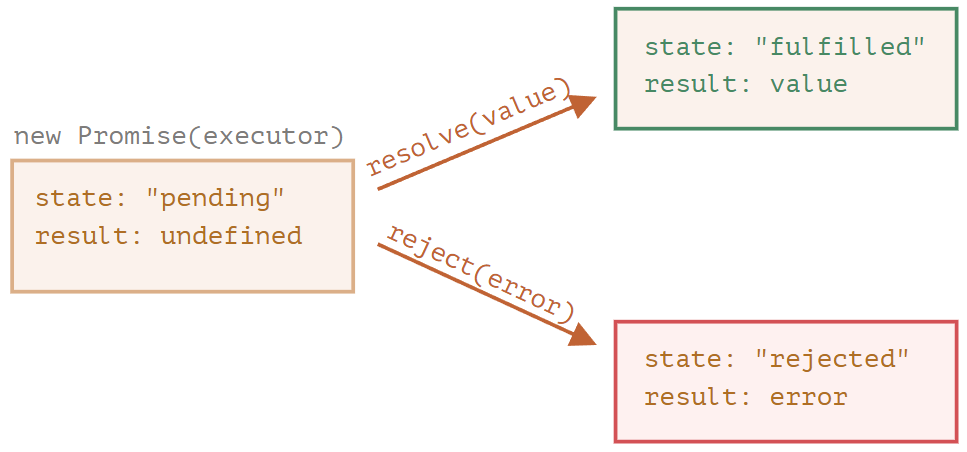
resolve函数的作用是,将Promise对象的状态从“未完成”变为“成功”(即从 pending 变为 resolved),在异步操作成功时调用,并将异步操作的结果,作为参数传递出去;
reject函数的作用是,将Promise对象的状态从“未完成”变为“失败”(即从 pending 变为 rejected),在异步操作失败时调用,并将异步操作报出的错误,作为参数传递出去。
//用于随机生成一个图片
function Image() {
    let result = Math.random();
    if (result > 0.5) {
        this.value = true;
    } else {
        this.value = false;
    };
}

let promise = new Promise(function (resolve, reject) {

    let image = new Image();
    console.log(image.value);

    if (image.value) {
        resolve('loaded');
    } else {
        reject(new Error("shit!!!"));
    }
});注意,调用resolve或reject并不会终结 Promise 的参数函数的执行。一般来说,调用resolve或reject以后,Promise 的使命就完成了,后继操作应该放到then方法里面,而不应该直接写在resolve或reject的后面。所以,最好在它们前面加上return语句,这样就不会有意外。
new Promise((resolve, reject) => {
  resolve(1);
  console.log(2);
}).then(r => {
  console.log(r);
});
// 2
// 1
Promise 对象的 state 和 result 属性都是内部的。我们无法直接访问它们。但我们可以对它们使用 .then/.catch/.finally 方法。我们在下面对这些方法进行了描述。
Promise实例生成以后,可以用then方法分别指定resolved状态和rejected状态的回调函数。then方法可以接受两个回调函数作为参数。第一个回调函数是Promise对象的状态变为resolved时调用,第二个回调函数是Promise对象的状态变为rejected时调用。这两个函数都是可选的。它们都接受Promise对象传出的值作为参数。
promise.then(
  function(result) { /* handle a successful result */ },
  function(error) { /* handle an error */ }
);promise.then(
result => { console.log(result) },//loaded
error => { console.log(error) }//Error: shit!!!
).catch(f) 调用是 .then(null, f) 的完全的模拟,它只是一个简写形式。 一般使用then来处理结果,使用catch来处理错误。
finally 的功能是设置一个处理程序在前面的操作完成后,执行清理/终结。
new Promise((resolve, reject) => {
  return resolve(1);
  // 后面的语句不会执行
  console.log(2);
})getJSON('/posts.json').then(function(posts) {
// ...
}).catch(function(error) {
// 处理 getJSON 和 前一个回调函数运行时发生的错误
console.log('发生错误!', error);
});上面代码中,getJSON()方法返回一个 Promise 对象,如果该对象状态变为resolved,则会调用then()方法指定的回调函数;如果异步操作抛出错误,状态就会变为rejected,就会调用catch()方法指定的回调函数,处理这个错误。另外,then()方法指定的回调函数,如果运行中抛出错误,也会被catch()方法捕获。
p.then((val) => console.log('fulfilled:', val))
  .catch((err) => console.log('rejected', err));

// 等同于
p.then((val) => console.log('fulfilled:', val))
  .then(null, (err) => console.log("rejected:", err));
// 写法二
const promise = new Promise(function(resolve, reject) {
  reject(new Error('test'));
});
promise.catch(function(error) {
  console.log(error);
});
如果 Promise 状态已经变成resolved,再抛出错误是无效的。
const promise = new Promise(function(resolve, reject) {
  resolve('ok');
  throw new Error('test');
});
promise
  .then(function(value) { console.log(value) })
  .catch(function(error) { console.log(error) });
// ok
上面代码中,Promise 在resolve语句后面,再抛出错误,不会被捕获,等于没有抛出。因为 Promise 的状态一旦改变,就永久保持该状态,不会再变了。一般来说,不要在then()方法里面定义 Reject 状态的回调函数(即then的第二个参数),总是使用catch方法。Promise 对象的错误具有“冒泡”性质,会一直向后传递,直到被捕获为止。也就是说,错误总是会被下一个catch语句捕获。
getJSON('/post/1.json').then(function(post) {
  return getJSON(post.commentURL);
}).then(function(comments) {
  // some code
}).catch(function(error) {
  // 处理前面三个Promise产生的错误
});跟传统的try/catch代码块不同的是,如果没有使用catch()方法指定错误处理的回调函数,Promise 对象抛出的错误不会传递到外层代码,即不会有任何反应。
const someAsyncThing = function () {
    return new Promise(function (resolve, reject) {
        // 下面一行会报错,因为x没有声明
        resolve(x + 2);
    });
};

someAsyncThing()
    .then(function () {
        console.log('everything is great');
    })
    .catch((err) => {
        console.error(err);
    })
经过我的实验,是这样的,这样有bug了也不会报错,嘻嘻 一般总是建议,Promise 对象后面要跟catch()方法,这样可以处理 Promise 内部发生的错误。catch()方法返回的还是一个 Promise 对象,因此后面还可以接着调用then()方法。
const someAsyncThing = function() {
  return new Promise(function(resolve, reject) {
    // 下面一行会报错,因为x没有声明
    resolve(x + 2);
  });
};

someAsyncThing()
.catch(function(error) {
  console.log('oh no', error);
})
.then(function() {
  console.log('carry on');
});
// oh no [ReferenceError: x is not defined]
// carry onfinally()方法用于指定不管 Promise 对象最后状态如何,都会执行的操作。该方法是 ES2018 引入标准的。
promise
.then(result => {···})
.catch(error => {···})
.finally(() => {···});
Promise链
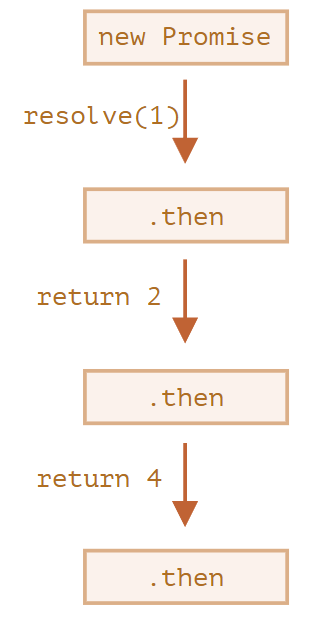
使用链式调用来实现对结果和错误的精细处理:
let promise = new Promise(function (res,rej) {
    res(1);
})

promise.then((res) => {

    console.log(res);//1
    return res * 2;

}).then((res) => {

    console.log(res);//2
    return res * 2;

}).finally(() => {

    console.log('finished!!!');//finished!!!

})
如果将一个promise对象上添加多个then,他们是彼此独立的,并不是一个链式的结构。 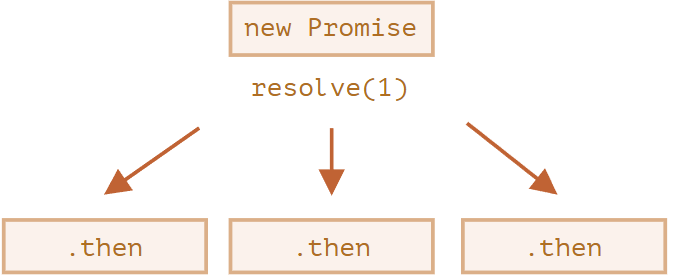
.then(handler) 中所使用的处理程序(handler)可以创建并返回一个 promise。
确切地说,处理程序返回的不完全是一个 promise,而是返回的被称为 “thenable” 对象 —— 一个具有方法 .then 的任意对象。它会被当做一个 promise 来对待。
这个想法是,第三方库可以实现自己的“promise 兼容(promise-compatible)”对象。它们可以具有扩展的方法集,但也与原生的 promise 兼容,因为它们实现了 .then 方法。
let promise = fetch(url);执行这条语句,向 url 发出网络请求并返回一个 promise。当远程服务器返回 header(是在 全部响应加载完成前)时,该 promise 使用一个 response 对象来进行 resolve。
fetch('/article/promise-chaining/user.json')
  // 当远程服务器响应时,下面的 .then 开始执行
  .then(function(response) {
    // 当 user.json 加载完成时,response.text() 会返回一个新的 promise
    // 该 promise 以加载的 user.json 为 result 进行 resolve
    return response.text();
  })
  .then(function(text) {
    // ……这是远程文件的内容
    alert(text); // {"name": "iliakan", "isAdmin": true}
  });
从 fetch 返回的 response 对象还包含 response.json() 方法,该方法可以读取远程数据并将其解析为 JSON。
// 同上,但使用 response.json() 将远程内容解析为 JSON
fetch('/article/promise-chaining/user.json')
  .then(response => response.json())
.then(user => alert(user.name)); // iliakan,获取到了用户名promise.then(f1, f2);
promise.then(f1).catch(f2);这两个例子是不一样的: 不同之处在于,如果 f1 中出现 error,那么在这儿它会被 .catch 处理 .then 将 result/error 传递给下一个 .then/.catch。所以在第一个例子中,在下面有一个 catch,而在第二个例子中并没有 catch,所以 error 未被处理。
错误处理
正如我们已经注意到的,链尾端的 .catch 的表现有点像 try..catch。我们可能有许多个 .then 处理程序,然后在尾端使用一个 .catch 处理上面的所有 error。
在常规的 try..catch 中,我们可以分析 error,如果我们无法处理它,可以将其再次抛出。对于 promise 来说,这也是可以的。
如果我们在 .catch 中 throw,那么控制权就会被移交到下一个最近的 error 处理程序。如果我们处理该 error 并正常完成,那么它将继续到最近的成功的 .then 处理程序。
new Promise(function(resolve, reject) {
  setTimeout(() => {
    throw new Error("Whoops!");
  }, 1000);
}).catch(alert);
不会进行处理,这里的错误并不是在 executor 运行时生成的,而是在稍后生成的。因此,promise 无法处理它。
Promise的静态方法(API)
all
如果任意一个 promise 被 reject,由 Promise.all 返回的 promise 就会立即 reject,并且带有的就是这个 error。 假设我们希望并行执行多个 promise,并等待所有 promise 都准备就绪。
let promise = Promise.all(iterable);Promise.all 接受一个可迭代对象(通常是一个==数组项为 promise 的数组==),并返回一个新的 promise。
当所有给定的 promise 都 resolve 时,新的 promise 才会 resolve,并且其结果数组将成为新 promise 的结果。
let names = ['iliakan', 'remy', 'jeresig'];

let requests = names.map(name => fetch(`https://api.github.com/users/${name}`));

Promise.all(requests)
  .then(responses => {
    // 所有响应都被成功 resolved
    for(let response of responses) {
      alert(`${response.url}: ${response.status}`); // 对应每个 url 都显示 200
    }

    return responses;
  })
  // 将响应数组映射(map)到 response.json() 数组中以读取它们的内容
  .then(responses => Promise.all(responses.map(r => r.json())))
  // 所有 JSON 结果都被解析:"users" 是它们的数组
  .then(users => users.forEach(user => alert(user.name)));
如果其中一个 promise 被 reject,Promise.all 就会立即被 reject,==完全忽略==列表中==其他的 promise==。它们的结果也被忽略。
例如,像上面那个例子,如果有多个同时进行的 fetch 调用,其中一个失败,其他的 fetch 操作仍然会继续执行,但是 Promise.all 将不会再关心(watch)它们。它们可能会 settle,但是它们的结果将被忽略。
Promise.all 没有采取任何措施来取消它们,因为 promise 中没有“取消”的概念。在 另一个章节 中,我们将介绍可以帮助我们解决这个问题(译注:指的是“取消” promise)的 AbortController,但它不是 Promise API 的一部分。
allSettled:
Promise.allSettled 等待所有的 promise 都被 settle,无论结果如何。结果数组会是这样的:
- 对成功的响应,结果数组对应元素的内容为
{status:"fulfilled", value:result}, - 对出现 error 的响应,结果数组对应元素的内容为
{status:"rejected", reason:error}。
let urls = [
  'https://api.github.com/users/iliakan',
  'https://api.github.com/users/remy',
  'https://no-such-url'
];

Promise.allSettled(urls.map(url => fetch(url)))
  .then(results => { // (*)
    results.forEach((result, num) => {
      if (result.status == "fulfilled") {
        alert(`${urls[num]}: ${result.value.status}`);
      }
      if (result.status == "rejected") {
        alert(`${urls[num]}: ${result.reason}`);
      }
    });
  });

[
  {status: 'fulfilled', value: ...response...},
  {status: 'fulfilled', value: ...response...},
  {status: 'rejected', reason: ...error object...}
]
没看完
Promisification
指将一个接受回调的函数转换为一个返回 promise 的函数。
//改造前
function loadScript(src, callback) {
  let script = document.createElement('script');
  script.src = src;

  script.onload = () => callback(null, script);
  script.onerror = () => callback(new Error(`Script load error for ${src}`));

  document.head.append(script);
}

// 用法:
// loadScript('path/script.js', (err, script) => {...})


//改造后
let loadScriptPromise = function(src) {
  return new Promise((resolve, reject) => {
    loadScript(src, (err, script) => {
      if (err) reject(err);
      else resolve(script);
    });
  });
};

// 用法:
// loadScriptPromise('path/script.js').then(...)
在实际开发中,我们可能需要 promise 化很多函数,所以使用一个 helper(辅助函数)很有意义。 我们将其称为 promisify(f):它接受一个需要被 promise 化的函数 f,并返回一个包装(wrapper)函数。
function promisify(f) {

  return function (...args) { // 返回一个包装函数(wrapper-function) (*)

    return new Promise((resolve, reject) => {
      function callback(err, result) { // 我们对 f 的自定义的回调 (**)
        if (err) {
          reject(err);
        } else {
          resolve(result);
        }

      }

      args.push(callback); // 将我们的自定义的回调附加到 f 参数(arguments)的末尾
      f.call(this, ...args); // 调用原始的函数
    });

  };

}

// 用法:
let loadScriptPromise = promisify(loadScript);
loadScriptPromise(...).then(...);
微任务
promise 的处理程序 .then、.catch 和 .finally 都是异步的。 即便一个 promise 立即被 resolve,.then、.catch 和 .finally 在promise后的代码也会在这些处理程序之前被执行:
let promise = Promise.resolve();

promise.then(() => alert("promise done!"));

alert("code finished"); // 这个 alert 先显示
异步任务需要适当的管理。为此,ECMA 标准规定了一个内部队列 PromiseJobs,通常被称为“微任务队列(microtask queue)”(V8 术语):
- 队列(queue)是先进先出的:首先进入队列的任务会首先运行。
- 只有在 JavaScript 引擎中没有其它任务在运行时,才开始执行任务队列中的任务。
当一个 promise 准备就绪时,它的 .then/catch/finally 处理程序就会被放入队列中:但是它们不会立即被执行。当 JavaScript 引擎执行完当前的代码,它会从队列中获取任务并执行它。 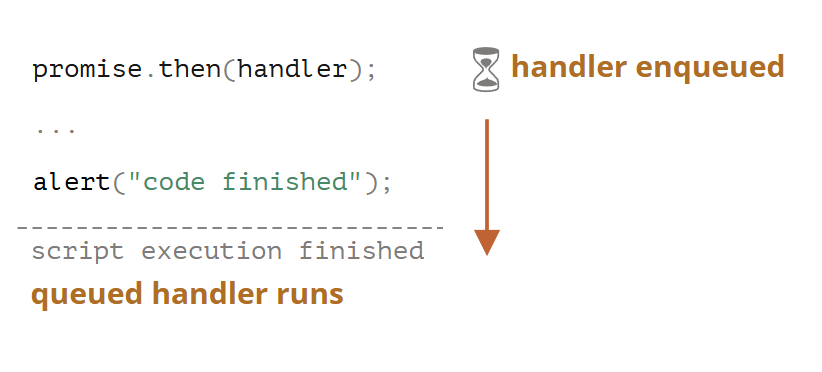
如果一个 promise 的 error 未被在微任务队列的末尾进行处理,则会出现“未处理的 rejection”。
async/await
promise在解决地狱回调的同时,但在使用时有一些不优雅 async/await 是以更舒适的方式使用 promise 的一种特殊语法,同时它也非常易于理解和使用。
使用async关键字在函数前,函数就会总是返回一个promise对象。其他值将自动被包装在一个 resolved 的 promise 中。
await只在 async 函数内工作,关键字 await 让 JavaScript 引擎等待直到 promise 完成(settle)并返回结果
像 promise.then 那样,await 允许我们使用 thenable 对象(那些具有可调用的 then 方法的对象)。这里的想法是,第三方对象可能不是一个 promise,但却是 promise 兼容的:如果这些对象支持 .then,那么就可以对它们使用 await。
要声明一个 class 中的 async 方法,只需在对应方法前面加上 async 即可:
class Waiter {
  async wait() {
    return await Promise.resolve(1);
  }
}

new Waiter()
  .wait()
.then(alert); // 1(alert 等同于 result => alert(result))async function f() {
try {
let response = await fetch('http://no-such-url');
} catch(err) {
alert(err); // TypeError: failed to fetch
}
}
f();
async function f() {
let response = await fetch('http://no-such-url');
}
// f() 变成了一个 rejected 的 promise
f().catch(alert); // TypeError: failed to fetch // (*)当我们使用 async/await 时,几乎就不会用到 .then 了,因为 await 为我们处理了等待。并且我们使用常规的 try..catch 而不是 .catch。这通常更加方便。
使用同步的写法来实现异步的效果,十分的优雅 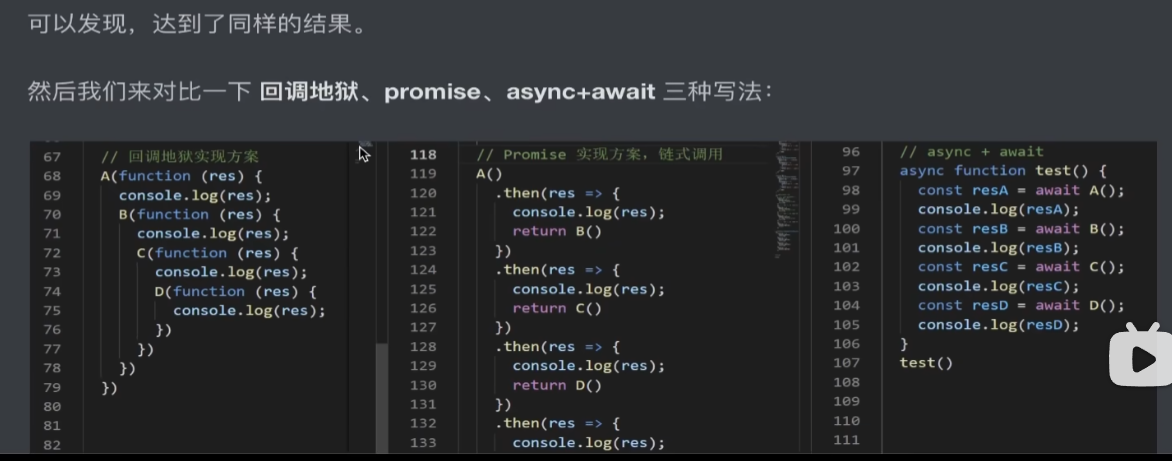
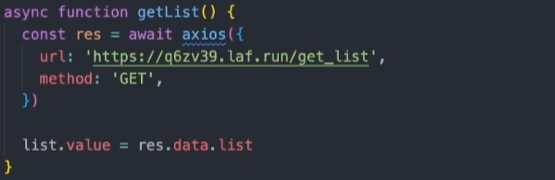 这个函数中使用
 await 是因为 axios(...) 会返回一个 Promise 对象,而 await 的作用正是等待这个 Promise 完成(成功或失败),并获取其返回结果。
具体原因如下:
axios是基于 Promise 的请求库,调用axios(...)后会立即返回一个 Promise(此时请求正在异步执行),而非直接返回接口响应数据。若不使用
await,代码会继续执行后续的list.value = res.data.list,但此时res还未获取到真正的响应结果(因为请求还没完成),会导致res是一个未完成的 Promise,进而报错。使用
await后,函数会暂停执行,等待axios的请求完成并拿到响应结果后,再将结果赋值给res,确保后续代码能正确使用接口返回的数据。
简单说,await 是为了将异步请求的结果 “同步化” 处理,让代码按照 “发送请求→等待结果→处理结果” 的逻辑顺序执行,避免异步操作导致的数据获取时机问题。